
What is DSP?
DSP stand for Digital Signal Processing and is a collection tuning tools that allows you to fine tune your audio system to maximise its sound quality. These tuning tools include crossover filtering to ensure each speaker is playing within its optimum band of frequencies, equalisation that typically provides 15 or 30-bands of GEQ (Graphic EQ) or PEQ (Parametric EQ) for each individual channel, as well as individual channel time correction to delay the sound from the speakers closest to the listening position compared to those farther away so that they all arrive simultaneously.
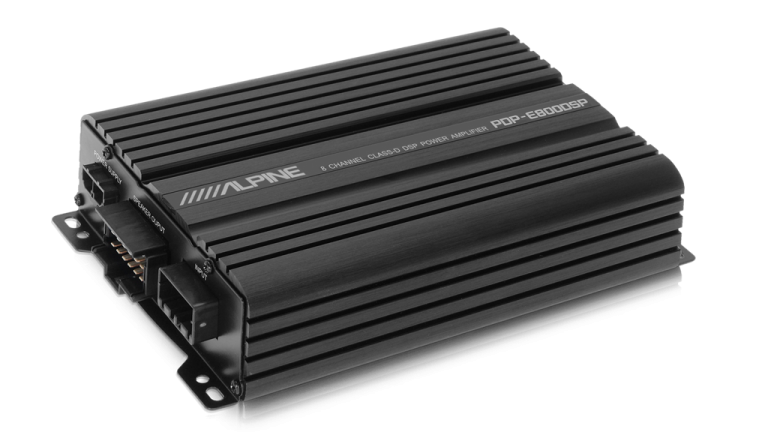
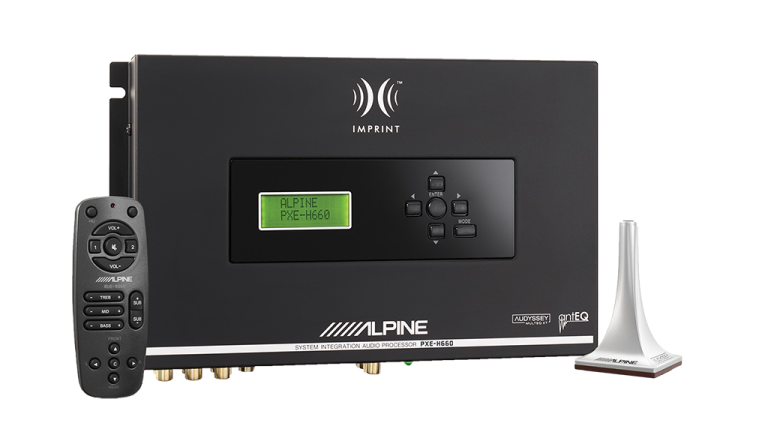
Adding DSP to your vehicle’s sound system can be done in a few ways. Some high-end head units offer decent DSP, while the most advanced DSP is found in stand-alone signal processors designed to be inserted into the signal stream between the head unit and amplifier/s. Alternatively, you can buy an amplifier with DSP built in.
A DSP processor or DSP amplifier will also house highly flexible input stages that can accept either speaker level, RCA level, and often toslink or coaxial style digital signal inputs that allow as few as one pair or as many as a dozen pairs of incoming music signals from prior devices. They then have input matrixing that allows you assign either left, right, or mono music signals to any output channel. There will also be auto turn on/off input signal sensing, as well as a triggered 12V output to feed to additional amplifiers in the system.
Why is DSP better than what you already have?
While you can find very good DSP built into a number of aftermarket head units that can do a great job of tuning your sound system, none of them are as advanced as you will find in any of the stand-alone processors or DSP-equipped amplifiers on the market.
The crossover filters in head units are limited to pre-ordained frequencies with a choice as few as four or five, while filter slopes will rarely exceed 24dB per octave. DSP units offer an infinite choice of filter frequencies between 20Hz and 20,000 in a little as 1Hz increments, while filter slopes can be as steep as 60dB per octave. All channels can also have both high and low pass filters able to be enacted, allowing band-pass filtering when required for all channels.
The equalisation in head units is usually GEQ (Graphic EQ) offering between 10 to 15-bands whereby all bands affect all six output channels simultaneously. In this way, if only one speaker is causing an issue the tune will still affect all the other speakers in the system – which is far less than ideal. DSP units offer 15 or 30/31-bands of true parametric EQ for each individual channel, allowing you to tune one speaker at a time without affecting any others. Parametric EQ in DSP units is also unlimited in the frequency selection between 20Hz and 20,000Hz, while the ‘Q-factor’ width of the boost or cut curve will also be tuneable in minute increments that is simply not possible with head unit-based DSP.
What are the differences between lower and higher priced DSP units and amplifiers?
While there may be some small variances from DSP unit to DSP unit, the fundamental tuning capability and flexibility of all DSP models on sale is essentially the same – so no matter what your budget you can get an incredible result. Also, there’s almost no chance of obsolescence (especially if the unit has a digital input) and this means it can be transferred from vehicle to vehicle for literally decades to come – making DSP a great investment.
Higher priced DSP units will offer more channels of inputs and/or outputs, have additional input sources, offer dashboard mountable remote-control interfaces to adjust levels and switch between presets, will have higher specifications for noise floor or frequency response, and offer features like Hi-Res music certification. Some units will also offer automated tuning systems make tuning the sound system by the home DIY user a cinch, whereas others will interface with highly advanced measurement equipment that can be best utilised by professional installers.
How do you add DSP to your system?
You can add DSP to any car even if its sound system is completely factory standard and still get incredible sound quality improvements. For vehicles that use an aftermarket head unit and external amplifiers a DSP processor inserts in the music signal stream between the head unit and amplifiers – typically via RCA style inputs and outputs. For vehicles with the OEM factory head unit a DSP processor can accept speaker level or digital level inputs and feed the processed music signal via RCA outputs to external amplifiers.
For a completely factory standard vehicle with an integrated head unit and sound system you can even install a DSP-equipped amplifier using either speaker level or digital input signals. The DSP-amplifier can also then replace any factory amplifier the vehicle may have been fitted with. In this instance you need to select a DSP amplifier with the same number of channels as the factory system requires.
How do you tune DSP?
All DSP units are tuned by being connected via a USB cable to a PC or laptop, with a bespoke tuning program that is download from each brand’s own website providing the graphic user interface to control all aspects of the DSP. All types of DSP software are compatible with Windows PC, while some can also work with Apple systems. If you have an Apple computer is worth checking its compatibility with any prospective DSP unit you are considering. Some DSP units can also be tuned via a smartphone app, but in some cases the full functionality of the DSP may only be accessible via the USB-connected PC tuning interface.
Should you buy a DSP processor or DSP amplifier?
If you have an existing sound system of amplifiers and speakers (with either an OEM or aftermarket head unit) then adding a stand-alone DSP processor may be the simplest and easiest upgrade, since it simply inserts in the signal stream between the head unit and amplifiers. All you may need are the extra RCA cables to get connected. Stand alone DSP processors also allow you to choose the amount of amplifier power you want so offer greater flexibility and are likely to be more adaptable to future installations if you keep the components for future vehicles you may own. However, there are some DSP amplifiers that have RCA outputs for all channels (like Alpine’s PXE-C80-88) so could be used as either an amplifier, a processor, or a mix thereof.
If you are upgrading a vehicle and have not chosen amplifiers yet, then a DSP amplifier may be a better choice. The installation is simplified as all the wiring goes to one location. There are DSP amplifiers available with as few as five or as many as 14 channels, so virtually any type of system design is catered for.