

How do brake rotors work?
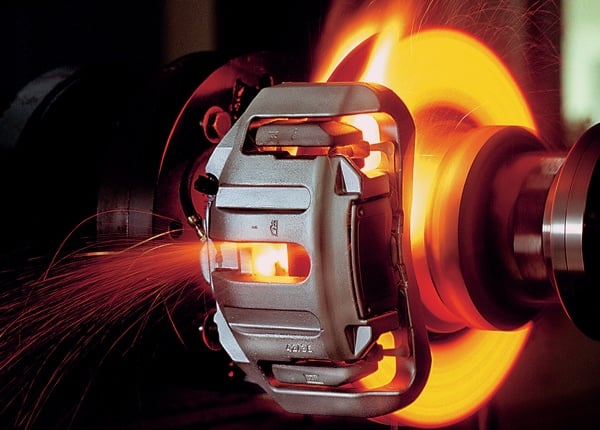 Your seemingly innocuous disc brake rotors perform one of the most important jobs on the car, being responsible for handling the tremendous heat generated in slowing down a speeding 1,500+kg object in a timely fashion, converting this kinetic energy into heat by the action of brake pads generating friction against the rotor. With braking events generating temperatures of several hundred degrees Celsius, properly functioning brakes should be a top safety consideration along with the quality and condition of your tyres.
Brake rotors are responsible for several functions – providing a friction surface for the brake pads, temporarily storing heat, and dissipating that heat. Anyone who regularly tows a trailer or caravan, or lives near a mountain road, is most likely familiar with the smell of overheated brakes, and may have experienced unsettling brake fade that results when your brakes get too hot.
What are the different types of brake rotors?
OEM replacement braking solutions come in all manner of sizes, shapes, and configurations. Below we'll discuss these in a bit more detail.
Solid verses ventilated rotors:
 Early disc brake designs featured a solid rotor, which quickly progressed to ventilated designs, the latter essentially two disc faces joined together by a network of pillars. Vented disc brake rotors significantly increasing the surface area for heat dissipation. Most modern cars will feature ventilated disc brake rotors front and rear, but smaller and lighter cars can meet modern safety standards with solid disc brake rotors on the rear.
These features are standard to your car and can’t be easily changed, as they are intrinsically linked to other components including the brake pads and callipers, but the design of the rotor can be tweaked, and thus enters the aftermarket. Upgraded rotor designs can enhance repeated brake efforts, or maximise service life of brake pads on a standard car. Due to the extra heat generated with performance brake pads, upgraded rotors can quickly become a necessary addition to any higher performance (or improved performance) vehicle.
Drilled, cross-drilled and dimpled rotors:
 A simple modification to a standard rotor, a series of holes drilled through the rotor face allow an even greater surface area for heat dissipation. An added benefit of these holes is permitting gasses to escape from the junction of brake pad and brake rotor – the tremendous heat generated can cause the brake pad to sublimate, creating small amounts of gas capable of pushing the pad off the disc brake rotors, leading to an inconsistent pedal feel and unpredictable braking performance.
The designs can vary, with holes being drilled either through one or both sides of a ventilated disc brake rotor, or through the pillars that join each half. Dimpled rotors are a similar concept, but don’t fully penetrate the rotor, giving increased thermal mass and no compromise to rigidity, but still aiding in gas escape. Typically a great entry level for sports cars or those looking to enhance their cars aesthetics.
Slotted rotors:
 Featuring on high end performance cars from factory, slotted rotors are a common sight at track days and amongst motoring enthusiasts. Like drilled rotors, slotted rotors have an increased passive cooling over a standard rotor, and also facilitate the removal of brake dust.
Brake dust is formed through normal braking, where the ablative material comes apart in the normal act of generating friction. This can be affected by many factors, such as relative hardness and softness of the pad and rotor, or by using a more aggressive pad, but for the common driver this most likely going to be caused by excessive heat in the brake system. This excess brake dust can coat the rotor face, and with the greater heat involved, can form a glaze that covers the disc surface, both compromising the brake pad’s ability to slow the car, and also how the rotor can manage the heat. Slotted rotors allow more brake dust to escape, giving more consistent braking in harsher environments. Typically a must for high performance vehicles, vehicles with increased GVM or those who tow and have upgraded to 4WD or Heavy Duty specific brake pads.
Brake rotor material:
 An often overlooked parameter, the material that the disc brake rotors are made from has a significant impact on the heat capacity of the braking system. Standard replacement disc brake rotors will meet or exceed OEM specified materials and performance characteristics, so you need not worry about buying something worse than standard when looking to the aftermarket, but high performance or high demand vehicles will benefit greatly from an improved base metal in the rotor. If you consider the braking system to behave like a cooling system, where a radiator is required to store excess heat before it can be dissipated, the metallurgy can be tailored to increase the specific heat capacity, without incurring a size or weight penalty.
This can be further improved by combining the superior compound with features such as cross-drilling or slotting.
What are the best brake rotors for my car?
 If you are after replacements for the original disc brake rotors on your car, a standard replacement rotor will meet your requirements at an economical fraction of the price of genuine replacement rotors. One must always consider the driving environment, those with longer commutes, harsher terrain, or consistently carrying heavier loads would do well to consider a mild upgrade.
If you drive a high-performance vehicle, or yours is a modified vehicle with performance credentials to match, it is highly beneficial to select a disc brake rotor with the type of features that match your driving style, brake pad choice and condition, for the best braking performance tailored for your needs. If your vehicle is a 4WD or dual cab and you're after an upgrade to improve your braking capacity when traversing steer roads or towing heavy loads, be sure to check our Brake Upgrade Kits to find a suitable solution for your specific make and model. If your vehicle has discs up front and drums in the rear, check out our Brake Shoes category.


