
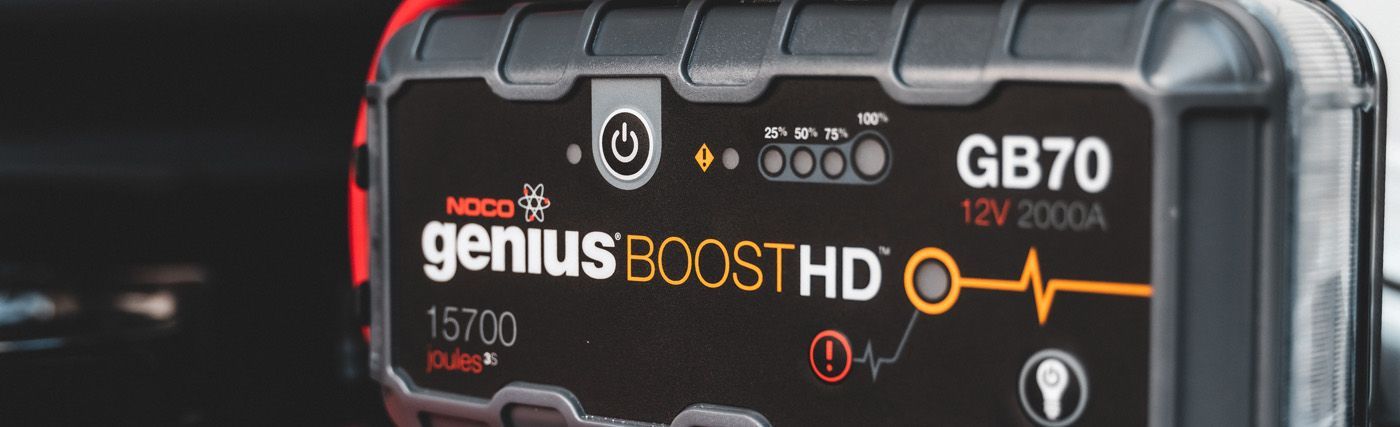
When looking for a car jump starter, there are several important features and factors to consider in order to ensure you choose the right one for your needs. Here are some key features and considerations:
Jumping Power – It is important to make sure the jump starter you choose has ample potential for your intended use application. Typical small to medium sized petrol-powered passenger vehicles can generally be started with 400A or more. Larger vehicles, luxury vehicles and diesel powered offroad vehicles generally will need 600A. Make sure the jump starter provides enough voltage and amperage to jump-start your vehicle's engine. Most cars require 12 volts, so choose a jump starter with at least 12V output. Amperage (measured in peak amps or cranking amps) should be sufficient to crank your engine. Typically, a jump starter with 400-800 peak amps should work for most compact and mid-sized cars.
Battery Type – Old school jump starters generally utilise a compact sealed lead-acid type battery. While relatively cheap they do have several shortcomings when compared to their contemporary alternatives including a larger and bulkier size, heavier mass and limited current potential. Newer examples utilising Lithium-ion (Li-ion) type batteries have become extremely popular in recent years, offering substantially reduced size and weight, increased starting potential and a range of useful safety features. Other jump starter don’t use a battery at all, using super capacitors instead of a battery to provide faster recharge times.
Capacity - Look for a jump starter with a sufficient battery capacity to not only jumpstart your vehicle but also to power other devices like smartphones, tablets, laptops or portable gaming consoles. The capacity of the jump starter is best measured in ampere-hours for a lead-acid battery based jump starter or watt-hours for a Lithium battery based jump starter. Note – Most common lead-acid battery based jump staters utilise an 18Ah 12V battery, so provide ~200Wh of energy for charging devices. A small Lithium based jump starter might have a capacity of 30-70Wh, whereas a larger Lithium jump starter might be 70-99Wh. It is unlikely you’ll find a Lithium battery based jump starter offering more than 99Wh of energy, as most manufacturers will want to keep the battery below the 100Wh threshold, so it can be shipped to customers with ease.
Portability – In the same way that the best camera is the one you have with you, so too is the best jump starter. Thus, the best jump starter to have is the one you are most likely to have with you. The jump starter you are most likely to have with you is the is the one that is most convenient to carry. Thus, the size and weight of the jump starter you choose has a disproportionate impact on how useful it is likely to be. By this metric a Lithium battery based jump starter, with its far greater space and weight efficiency, is far easier to carry around and store in your vehicle.
USB Ports and Other Outputs – In our modern, ultra-connected world, we are never far from civilisation, that is provided you don’t run out of power for your connected devices. Perhaps the most desirable additional feature you are likely to find on a jump starter is a facility to charge your mobile devices including smartphones, tablets, portable gaming consoles or even laptops. This is not only a vital feature to have should you find yourself in a spot of bother or some sort of emergency situation, it can also be hugely convenient to have a battery bank capable of charging your devices on hand to make sure you need not lose the ability to keep in touch with friends and family, stay abreast of current events, be productive or be entertained. The latest generation of mobile devices, portable computers and handheld gaming consoles utilise higher rate fast charging, so it can be a good idea to compare available charge rates (PD20W + PD60W for example).
Flashlight - Another extended feature commonly found in car jump starters is a flashlight. Perfect for situations where you need to find your way in the dark, illuminate a workspace, mark a hazard in the dark or to signal for assistance in the event you find yourself in distress, a built-in flashlight is a fantastic thing to have with you at all times. Look for models with adjustable lighting modes, such as continuous, strobe and SOS functions.
Display - A Jump Starter equipped with an LCD display can provide at a glance information on the jump starters state of charge and voltage, or that of the battery to be jumped. A display which is illuminated or backlit is preferable, as it can be viewed both during the day and at night.
Durability – Choosing a jump starter which is constructed with your intended use in mind is a necessity. For example, if you are likely to take it offroad then you are gonna want something with a suitably ruggedised case, so it has some level of resilience to mechanical damage. Ingress Protection is another key consideration in terms of durability. An IP rating that begins with a 6 (IP65) ensured protection from dust and similar particles you are likely to encounter when off the beaten track, whereas an IP ending with a 5 (IP65) ensures a moderate level of water resistance to the type of exposure you are likely to encounter out on the water.
Charging Options – Often overlooked, the rate at which the jump starter can be recharged can hugely impact convenience. After all, the last thing you wanna be doing is waiting the better part of a day to be able to use your jump starter for its intended purpose. Accordingly, comparing the charge options and rate is worthwhile. Some jump starters can only be charged via a standard USB interface, which can be limited to a rate of just 10-watts from most sources, or as little as 2.5-Watts if powered from an old USB 1.1 or 2.0 source. Other, more modern, chargers can be capable of charging via a USB-C interface capable of up to 60-Watts. For context, a 60Wh Lithium jump starter charged from a standard USB 2.0 source will take upwards of 24 hours to reach a full state of charge, whereas charged from a PD60W capable source and via a PD60W capable input could take as little as 1 hour. As you might expect, this could make a world of difference should you find yourself reliant on a jump starter that needs a recharge before use it can be used.
Warranty – While your rights as a consumer under Australian law entitles you to a product with a reason service life and acceptable quality, which cannot be excluded under law, the duration of the warranty period offered on one jump starter verses another is worth considering. Not only does a longer warranty period provide peace of mind, it is also a reflection on the confidence the manufacturer or supplier has in the product. Specific exceptions outlined in the warranty conditions might also be a factor to consider, in order to ensure you have the protection you need in the event of a defect or malfunction.
Price – While always best to consider your options in the context of price, it is not always best to purchase the cheapest option available. This is especially true when it comes to important tools and devices that can fail, leaving you helpless, or fail catastrophically, as is of particular concern when it comes to devices containing large or high-rate Lithium chemistry type batteries. It is also important to consider the comparative cost of one jump starter verses another in the context of their reflective feature sets. For example, jump starter offering 40% more cranking current, 50% more capacity, a higher rate of charge and a more capable cross section of Ios is arguably worth far more, dollar for dollar, than lesser alternatives.
Reviews and Ratings – When sizing up a particular jump starter it can be well worth your while seeking out customer reviews to gain a better understanding of exactly how capable and durable your selected model is in the field. Research customer reviews and ratings to get an idea of the jump starter's performance and reliability, and if you cannot find them then perhaps it isn’t the model, or the brand, for you.
In summary, the best jump starter to suit your application will depend on your specific needs and particular vehicle.


