

So, what is Hi-Resolution Audio?
Chances are, whether searching through the instruction manual of your latest vehicle, perusing the music download options of your favourite band or browsing Automotive Superstore for an aftermarket headunit, you’ve likely come across the term ‘Hi Resolution Audio’. But what does this mean exactly, and what difference does it really make to the listening experience?
An ever-increasing proportion of factory and aftermarket audio systems boast compatibility with what is known as High Resolution, or Hi Res, Audio. Hi-Res Audio is, simply put, a label applied to any type of digital audio recording which is more detailed than that of a conventional compact disc.
What is a Bitrate?
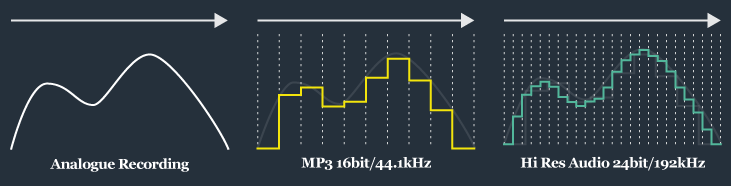
To understand what this means we must first get our heads around the concept of bit depth and sampling rate, something that applies to everything from the pictures you take to the movies you stream. You see, when turning a wonderfully sinuous analogue recording into a digital copy we must first determine two key parameters, the first being at what level of detail we will sample the waveform of the analogue recording, and second, how often we will sample it. What results is a stream of bit, or a bitstream. The higher the bit depth and more frequent the sampling rate, the higher the overall rate of bits, or bitrate.
What is good, better and best?
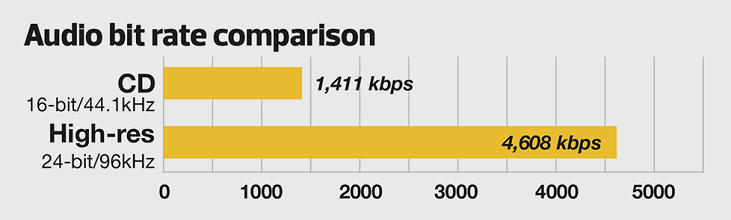
Compact Discs, for the most part, are encoded with a bit depth of 16bit, and at a rate of 44.1kHz (16bit/44.1kHz) per channel. This can be a bit hard to conceptualise in real terms but, to put it another way, imagine being able to record any number between 0 and 65,536 (2 to the 16th) 44100 times every second for each of the left and right stereo channels. This equates to 1,411,200bits of information per second or, to put it in terms that are comparable to the download speed of your internet connection, 176Kbps (0.176Mbps).
Most Hi-Res Audio files are sampled at a bit depth of 24bit, and sampled at 48kHz or more. This equates to a number between 0 and 16777215 (2 to the 24th) 48000 times per second, or 2,304,000 bits of information per second. In internet speed talk, that equals 288Kbps (0.288Mbps). Other popular hi resolution audio files up the sampling rate to 96kHz and 192kHz, which is equal to 576Kbps and 1.152Mbps respectively… the latter being close to a 10-fold increase in the data rate over a conventional CD, and a whopping 72 times more than that of your average YouTube audio stream or 128kbps mp3 file.
What are the advantages?
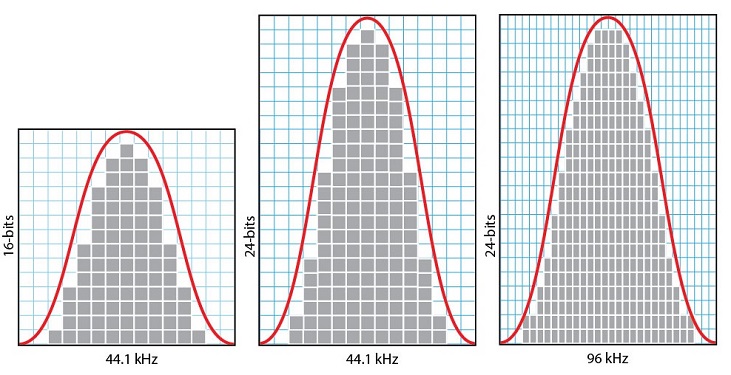
This increased data rate yields more accurate signals updated more often, translating to significantly higher quality sound, particularly in the higher sonic and supersonic range. In real terms this means more vibrant and detailed vocals, strings, woodwind, brass and percussion and other higher frequency musical elements, and substantially better quality upper harmonics extending up above our normal hearing range. Whether the downstream components of a given sound system such as the amplifier and speakers can reproduce, or whether we can hear, this increase in quality and detail is another story entirely, but that is it in a nutshell.
What are the file formats?
Travel a little bit down the hi-res audio wormhole and you’ll soon find yourself asking all sorts of strange questions, like… Why is WAV still a thing? WTF is FLAC? Is AIFF all that? Does ALAC sound as good? Is DSD worth the dick around?.. and so on. These are the various encoding formats native to the hi-res audio realm, or the language in which the bits are stored.

Format - WAV
WAV, short for Waveform Audio File Format, was developed by IBM and Microsoft way back in 1991 in line with the introduction of stereo sound to the Personal Computer. The WAV format allowed audio files of various qualities to be encoded, stored and played back on the humble PC, and was the first widely used format to be based on the Pulse-Code Modulation (PCM) method. It offers no option for audio compression.

Format - AIFF
AIFF, short for Audio Interchange File Format, is much like the WAV format, and was developed by Apple for much the same reason in 1991, and updated with the release of the OS X operating system It is also based on the Pulse-Code Modulation (PCM) method. A variation called AIFF-C can, be compressed up to half it’s normal size without any loss of audio quality.
Format - FLAC
FLAC, short for Free Lossless Audio Codec, is an open-source audio format developed by linux loving nerds who hate monopolistic a**holes like Bill Gates and Steve Jobs. FLAC, like the AIFF format, can be compressed to up half its original size and decompressed again without any loss of audio quality. The FLAC format is fast becoming the hi-res audio codec of choice thanks to it’s excellent capabilities and lack of expensive licences and/or proprietary controls.

Format - ALAC
Apple’s answer to FLAC, ALAC is basically just Apple’s attempt to enjoy all the benefits of the FLAC format without any of that consumer empowering ‘Free’ nonsense. Originally released in 2004, ALAC was only used by consumers trapped inside the Apple ecosystem, until 2011 when Apple stepped out of character, open sourcing the format for use by other proprietary technology hoarders like Sony.

Format - DSD
DSD, short for Direct Stream Digital, was originally developed by Sony and Philips for use with Super Audio Compact Discs (or SACDs). Delta-Sigma Modulation followed by Pulse Density Modulation. The technicalities of this are a bit too complex to go into here, but it is basically a two-part demodulation process that is theoretically capable of yielding better quality from a smaller file size.

Conclusion
So, now you know exactly what Hi-Resolution Audio is, what it does and why you want it… and if you would like to experience the benefits of Hi-Resolution Audio in your car, be sure to check out our expansive range of compatible headunits on Automotive Superstore dot com dot hey you by clicking here.


